
A global Boston Consulting Group study showed that while 94% of companies had embarked on agile initiatives, only 53% realized transformation targets, creating lasting shifts in culture, teamwork, and performance. BCG
When teams adopt the ceremonies but not the mindset, results suffer. What would change if your teams could be truly agile?
What's Possible with MGS

Turn ceremonies into accelerators, not checkboxes.
We show teams how to use Scrum events to create momentum. Planning, dailies, and reviews stop being obligations and start driving faster delivery. By practicing together, teams learn how just-enough structure speeds them up, like the lines on a highway, guiding without slowing them down.

Help teams move beyond rules to outcomes.
We teach the characteristics of an agile mindset: incremental delivery, owning the problem, continuous improvement, and leading with context, not control. Teams practice shifting from “we’re doing Scrum” to “we’re succeeding together”, and discover that repeated small wins make work both easier and more enjoyable.

Keep agile practices strong under pressure
Too often, teams abandon agile practices at the first big deadline. We give them the tools and mentoring to hold the line under pressure. By reinforcing behaviors and creating improvement communities, teams embed agility deeply enough that it lasts, so even in a crunch, they don’t slide back to old habits.
How We Can Help
Introduction to Agile
Learn core agile principles and practices teams use to respond to change and deliver results with less overhead.
Featured Topics
Overview of Agile
- Principles
- Leading Agile Approaches
- Scrum
- Kanban
- Extreme Programming
- Scaling Frameworks
Working in Iterations
- Timeboxed
- Collaboration
- Done Every Iteration
Roles on an Agile Team
- Product Owner
- Coach or Scrum Master
- Developers
- How Existing Roles Change
The Product Backlog
- A Good Product Backlog Is DEEP
- User and Job Stories as Backlog Items
- Backlog Refinement
- Adding Just Enough Detail Just in Time
Iteration Planning Meeting
- Purpose
- Two General Approaches
Iteration Review Meeting
- Who, When, Why?
- Agenda
Iteration Retrospective
- Who, When, Why?
Daily Meetings
- Purpose
- Troubleshooting Common Problems
Challenges Introducing Agile
- What Challenges Do You Anticipate?
Working on a Scrum Team
Clarify roles, events, and daily practices so your team reduces friction and works together more effectively.
Featured Topics
Scrum Overview
- Agile
- Scrum
- Why Scrum Works
The Development Team
- Rights & Responsibilities
- Self-Organizing
- Cross-Functional
- Collaborating during Sprints
- Component and Feature Teams
- Navigating Team Conflict
- Becoming a High-Performing Team
The Scrum Master
- Rights & Responsibilities
- Helping the Team
- Combined with Other Roles
The Product Owner
- What is a Product Owner?
- Rights & Responsibilities
- Business Analysts
- Product Managers
Managers
- Role of Managers in Scrum
Product Backlog
- Responsibilities & Attributes
- User, Job Stories, and Tech Stories
- Acceptance Criteria
- Story Writing & Refinement
- Story Splitting
Sprinting
- The Role of Design
- Collaborating
- Responding to Change
- Definition of Done
- Definition of Ready?
Estimating
- Relative Estimating
- Story Points
- Affinity Estimation
- Planning Poker
Planning
- Estimating Velocity
- Fixed-Date Planning
Sprint Planning
- The Sprint Goal
- Capacity-Driven Sprint Planning
- Velocity-Driven Sprint Planning
Daily Scrum
- Guidelines
- Two Different Approaches
- Online Daily Scrums
Sprint Review
- Inputs and Outputs
- Conducting the Review
- Guidelines
Sprint Retrospective
- Who, When, Why?
- Methods for Conducting Retrospectives
Agile for Leaders
Learn how leadership decisions and organizational systems shape speed, clarity, and outcomes.
Featured Topics
Benefits Of Agile
We explore why agile works and what organizations typically gain.
Topics include:
- Managing changing priorities
- Increasing visibility and transparency
- Improving business/technology alignment
- Increasing delivery speed
- Improving morale and engagement
- Productivity and time-to-market research findings
What Scrum Is (For Leaders)
Leaders don’t need to memorize rules—but they do need to understand the system they’re sponsoring.
Topics include:
- Scrum as a “brand of agile”
- Roles: Product Owner, Scrum Master, Developers
- Self-organizing teams
- Sprints and sprint constraints
- Product backlog evolution
- Story points vs. hours
- Velocity (and what it is not)
- Forecasting with velocity ranges
- Scrum events: Sprint Planning, Sprint Review, Retrospective, Daily Scrum, and refinement
Participants leave with a clear understanding of Scrum—and the leadership expectations it creates.
Leadership Behaviors That Determine Success (Customized)
Scrum often exposes organizational problems—but it won’t fix them automatically. Leaders can.
This section is customized to your organization. During a short planning call, we’ll identify the leadership behaviors most important to your success and focus on those.
Common Areas Of Focus Include:
- Demonstrating executive commitment
- Empowering teams and key roles
- Planning realistically in uncertainty
- Keeping teams stable long enough to become high-performing
- Prioritizing ruthlessly and limiting work in progress
- Protecting sprint goals so teams can focus and deliver
Q&A
Discussion, questions, and recommended next steps.
How We've Helped Other Teams

Strengthening Agile Consistency Across 50+ Scrum Teams
Using trusted principles and resources from Mountain Goat Software's blogs, tools, and course-informed practices this client built out their internal agile framework.
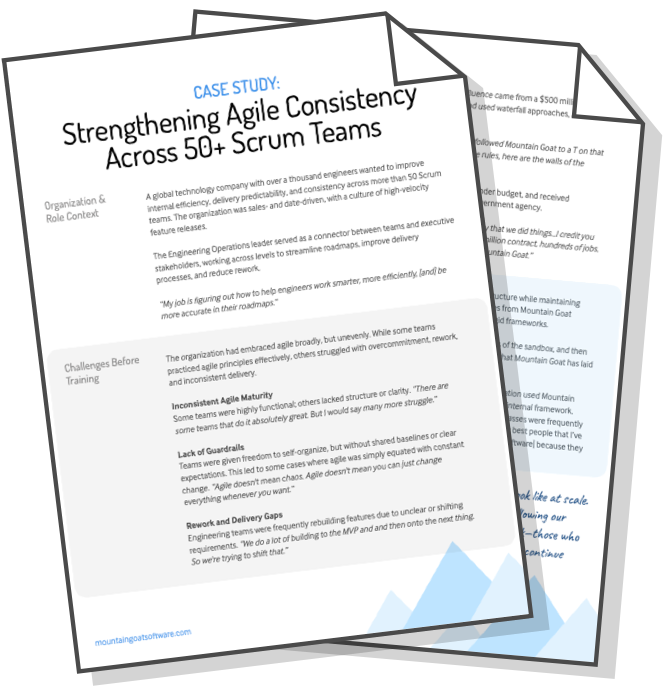 Read the Case Study
Mountain Goat Software helped us bring clarity to what agile should look like at scale. Their principles gave us a structured foundation to build on, while still allowing our teams the freedom to adapt. We’ve seen the difference in how people work—those who follow the Mountain Goat way just get it. It’s been a valuable guide as we continue evolving how we work
Engineering Operations Lead
Mountain Goat Software helped us set a shared baseline for agile practice across a wide range of experience levels. It was a valuable step in supporting consistency across the organization, without losing flexibility or respect for local context.
Chief of Staff











What happens when you contact us?
- We’ll get back to you within a day.
- Answer your training questions and discuss any custom needs.
- Recommend the best agile training path for your teams and goals.
- Want to talk to someone? Schedule a call.