
Projects that had strong governance support — either by a higher-level cross-functional or by a single high-level executive champion — had a 76% success rate. Those with moderate governance support had a 19% success rate. (Harvard Business Review)
Teams with a strong executive champion are more likely to succeed. See below how we can help your teams.
What's Possible with MGS

Shift from individual output to team success.
We show teams how to set meaningful multi-iteration goals and align daily work to them. Through role-specific training and collaborative exercises, members learn to step outside silos, share accountability, and create a culture where success is measured by outcomes delivered together.

Make collaboration more productive than coordination.
We train teams to use sprint events as genuine opportunities for collaboration, not just reporting. With guided practice, standups, planning, and reviews become moments where problems are solved in real time, reducing rework and making delivery faster and more consistent.

Keep teams aligned without rigid rules.
We support organizations in creating improvement communities that spread good practices across teams. These groups recommend, not enforce, better ways of working, ensuring alignment grows organically. With ongoing mentoring, teams sustain productivity gains without sliding back into silos or over-reliance on process.
How We Can Help
Effective Product Owner
Learn how effective product owners manage a healthy backlog, work with stakeholders, and guide teams toward better outcomes.
Featured Topics
Scrum Overview
- Agile
- Scrum
The Product Owner
- What Is a Product Owner?
- Characteristics
- Responsibilities
- Product Owners in Different Contexts
- Quarterly Activities
- Involvement over Time
- Asking for Clarifications, Not Changes
- Dealing with Difficult Situations
- Business Analysts & Product Managers
- Scaling the Product Owner Role
Visioning
- Specifying the Problem, Not the Solution
- Creating a Concise Vision
- Five Techniques for Communicating Vision
Customers and Users
- Validating Assumptions
- User Roles
- User Role Modeling
- Personas
- Roles vs. Personas
- Decorated Roles & Extreme Characters
The Product Backlog
- What Is a Product Backlog?
- Progressive Elaboration
- Product Backlog Refinement
- User Stories
- Adding Detail to User Stories
- Job Stories
- Technical Stories
- Themes & Epics
- Splitting Stories with the SPIDR Approach
- Who Contributes Items?
- Story Writing Workshop
- Story Mapping
Prioritizing
- Key Concepts in Prioritization
- Factors in Prioritization
- Formal Approaches
- What Different Stakeholders Value
- Collaborative Prioritization Techniques
Planning
- Accuracy and Precision
- Velocity
- Using a Velocity Range
- Fixed-Date Plans
- Fixed-Scope Plans
Developers
- Responsibilities
- Component and Feature Teams
The Scrum Master
- Responsibilities
- Description of Role
Agile for Leaders
Learn how leadership decisions and organizational systems shape speed, clarity, and outcomes.
Featured Topics
Benefits Of Agile
We explore why agile works and what organizations typically gain.
Topics include:
- Managing changing priorities
- Increasing visibility and transparency
- Improving business/technology alignment
- Increasing delivery speed
- Improving morale and engagement
- Productivity and time-to-market research findings
What Scrum Is (For Leaders)
Leaders don’t need to memorize rules—but they do need to understand the system they’re sponsoring.
Topics include:
- Scrum as a “brand of agile”
- Roles: Product Owner, Scrum Master, Developers
- Self-organizing teams
- Sprints and sprint constraints
- Product backlog evolution
- Story points vs. hours
- Velocity (and what it is not)
- Forecasting with velocity ranges
- Scrum events: Sprint Planning, Sprint Review, Retrospective, Daily Scrum, and refinement
Participants leave with a clear understanding of Scrum—and the leadership expectations it creates.
Leadership Behaviors That Determine Success (Customized)
Scrum often exposes organizational problems—but it won’t fix them automatically. Leaders can.
This section is customized to your organization. During a short planning call, we’ll identify the leadership behaviors most important to your success and focus on those.
Common Areas Of Focus Include:
- Demonstrating executive commitment
- Empowering teams and key roles
- Planning realistically in uncertainty
- Keeping teams stable long enough to become high-performing
- Prioritizing ruthlessly and limiting work in progress
- Protecting sprint goals so teams can focus and deliver
Q&A
Discussion, questions, and recommended next steps.
How We've Helped Other Teams

Transforming the Department of Defense
To address the challenges of transitioning teams to agile, Mountain Goat Software developed a custom training program including two courses: Working on a Scrum Team and Effective Product Owner.
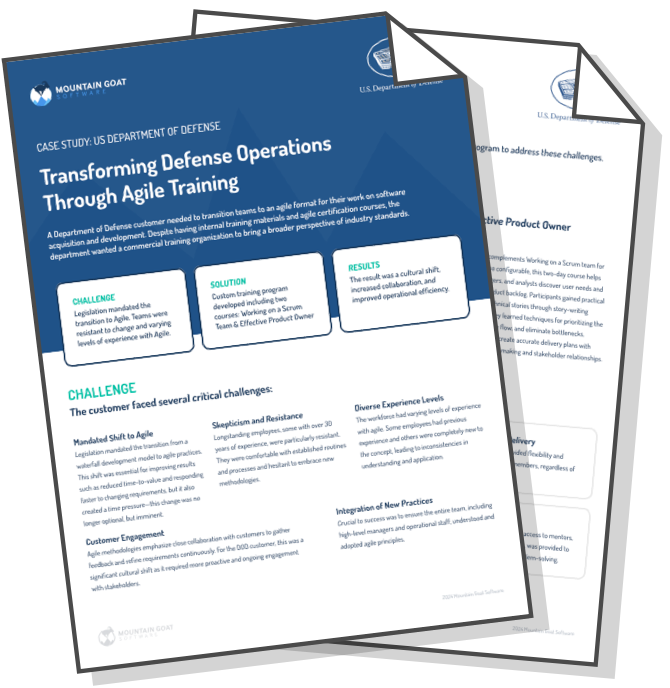 Read the Case Study
The hands-on workshops and real-life-scenario practices reinforced their learning and boosted confidence. The training program was invaluable. It brought everyone to the change together.
Department of Defense customer
Lance's "Working on A Scrum Team" training class was informative, interactive and engaging. Our teams found the onsite group training very effective to get everyone (Product Owners, Scrum Teams, Scrum Masters) aligned on the same concept, approach, and best practices… Most importantly, he still works with scrum teams in the trenches and is able to provide thoughtful suggestions for difficult situations.Lu F.Director PMO











What happens when you contact us?
- We’ll get back to you within a day.
- Answer your training questions and discuss any custom needs.
- Recommend the best agile training path for your teams and goals.
- Want to talk to someone? Schedule a call.